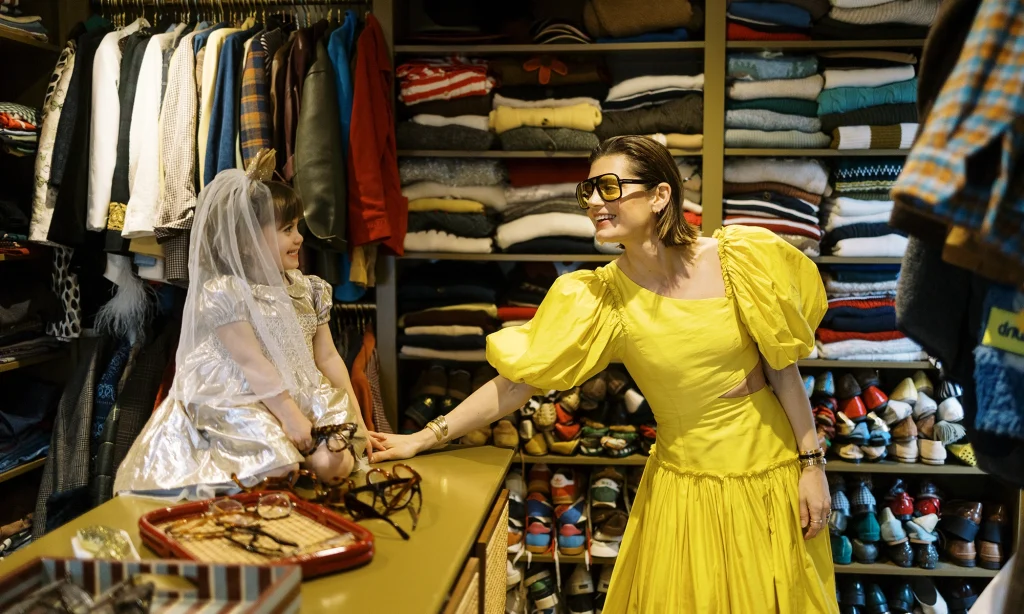
That thinking has already come to life in her recent children’s cashmere collection, created in collaboration with her son Alonso. “It was very special to work on something together,” she says. “It felt like a natural extension of both motherhood and my work.”
Now, as she settles into life with her second child, there is a deeper emotional layer to this season. “Very grateful, but also very humbled,” she says. “His arrival carries a tenderness because it didn’t come easily. I don’t take any part of it for granted.”
Her path to this moment was shaped by years of trying to conceive, followed by the discovery that both she and her husband were carriers of the same rare genetic condition. “It was one of the hardest moments we’ve experienced,” she shares. “Everything changed very quickly.”
What followed was a move into IVF, something she describes as both physically and emotionally demanding in ways she hadn’t anticipated. “It asked for patience and surrender,” she says. “The waiting is almost harder than the procedures. Waiting for results, for calls, for embryos, for transfer dates. It’s constant.” That sense of waiting, of holding your breath while trying to continue life as normal, becomes one of the defining parts of the experience. You realise you can do everything correctly and still need to surrender.”
After their first round, they were left with just two viable embryos. The first transfer resulted in a chemical pregnancy. “We were devastated. It was far harder than I had imagined.” She describes that period as one where she felt completely depleted, unsure if she had the strength to go through it again. “I didn’t know if I could put myself through another transfer,” she says. “It takes so much, physically and emotionally.” And yet, it was her son Alonso who offered a moment of perspective that stayed with her. “He said to me, ‘I am very sad too, but don’t be sorry because it happened.’”It was such a simple way of holding both sadness and gratitude at once. “That moment shifted something in me. It reminded me that even difficult experiences can hold something meaningful.”
When they decided to try again, Alejandra approached it differently.“I focused on staying calm. I felt at peace with whatever the outcome would be because I understood I couldn’t control it.” “You can do everything right and still not have a guaranteed outcome. Timing becomes something you respect rather than manage.”
Support also became essential. Not just practically, but emotionally. “My husband came to every appointment, he cooked for us, he really held everything together,” she says. “My son would give me kisses after injections. My friends were constantly checking in.”
She also began working with a perinatal therapist, something she describes as incredibly important. “It gave me space to process everything. The loss, the fear, the uncertainty. It helped me stay present instead of always anticipating what could go wrong.”
Following a traumatic first birth and postpartum experience, she has been intentional about doing things differently this time.
“This time I’ve really tried to make the experience my own. To not let it be shaped by fear or other people’s expectations.” That has meant building a support system around her that feels aligned, from her medical team to her broader circle. “I’ve surrounded myself with people who make me feel safe and supported. That has made such a difference.”
During IVF, her relationship with work also shifted. “Work became an anchor because creating grounded me,” she says. “But I also had to release perfectionism. I learned to design in a softer way, slower, more intuitive.” There is a sense that everything, motherhood, fertility, creativity, has brought her closer to what feels true. That same shift is reflected in how she now thinks about legacy. “Legacy is no longer abstract to me,” she says. “It’s very personal now.” It’s not about what you leave behind in a material sense, but what you pass on.“I want my children to see that creating with integrity matters. That patience matters. That beauty can be meaningful. That how you do things is just as important as what you do.”
When asked what she would say to women navigating a similar journey, her response is simple but deeply felt. “You are not alone, even if it feels very isolating. And none of this is your fault.” It’s a reminder of how many women are moving through similar experiences, often quietly, often without the space to fully express what they are carrying.
Alejandra’s story is not just about motherhood or fertility. It’s about learning to move through uncertainty, to let go of control, and to find meaning in both the difficult and the beautiful moments along the way.
In her world, creativity and motherhood don’t compete. They inform one another. They deepen one another. And perhaps that’s what makes her story resonate so strongly. Beneath the collections, the craft and the aesthetic, there is something much more lasting, a life being built with care, intention and real feeling behind it.