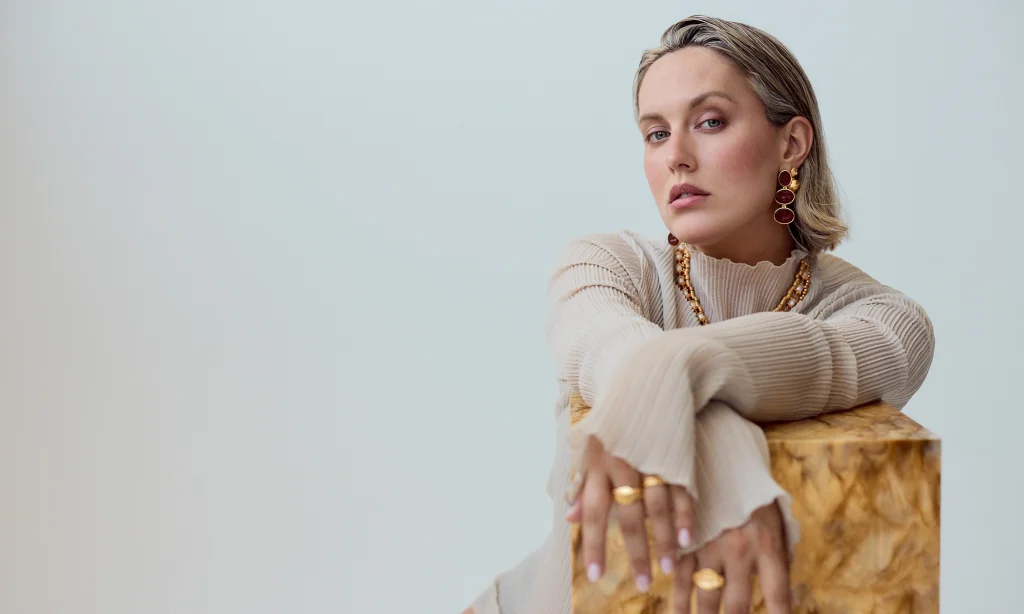
Supporting the journey of motherhood, in style

Kirsten King on Movement, Motherhood and the Art of Returning to Yourself

Founder of Fluidform, mother of three, and the visionary leader redefining modern Pilates and women’s wellness from the inside out.

Words by Courtney McIntosh | Photography by Caroline McCredie

In celebrating Kirsten King’s thoughtful approach to movement, pregnancy and women’s wellbeing, we’re delighted to share an exclusive offering for THE INARRA community: enjoy 30% off Fluidform at Home Yearly Subscriptions using the code ff-inarra-30 at checkout. Available via the Fluidform app.

There is a grounded confidence in Kirsten King, the founder and visionary behind Fluidform Pilates. She is more than the driving force behind a global movement brand. She is a teacher, entrepreneur, and advocate who has built an entire ecosystem around connection, care, and empowerment, one that stays with you long after you leave the studio.

Kirsten carries the calm presence of someone who has lived deeply, who has experienced both loss and light, and learned to turn experience into strength. When she speaks, there is no gloss or performance, just a woman with purpose: to help others reconnect with their bodies, their confidence, and themselves.

“Your past shapes you, the good and the hard,” she tells THE INARRA. “You don’t realise how much until you look back.”

Born and raised on the Gold Coast, Kirsten’s childhood was everything you would imagine of coastal Australia in the early 1980s: barefoot bike rides, endless afternoons in the pool, hair tinged green from chlorine, and the scent of salt and sunscreen that lingered on the skin.

“It was so simple,” she says. “Riding bikes until the streetlights came on, eating watermelon that Mum scooped into perfect little balls, playing cricket in the driveway with my brother’s friends. It was the kind of childhood you want your own kids to have.”

Her parents worked hard, her father in business and her mother juggling full-time work with motherhood. Her grandparents lived close by. “We were surrounded by love,” she says. “Mum was very close to her parents and siblings, so there was always someone around. It was a community, not just a household.”

Life changed dramatically when Kirsten was 16. Her older brother was killed in a car accident, a loss that altered her world. “It completely shifted the axis of who we were,” she says quietly. “I don’t think I understood at that age how deeply it would affect my parents until I became a mum myself. That loss taught me perspective, empathy, and strength. It has shaped every part of who I am.”

Movement was always a part of her life, from dance and tennis to long days in the ocean, but her understanding of health evolved over time. “In the 80s, we thought Milo was a health drink,” she laughs. “There was no wellness culture, but we were always outside, always moving. That created the foundation.”

After high school she considered becoming a physiotherapist, until an internship in a clinical practice changed her mind. “It was all blue curtains and cubicles, and I just knew it wasn’t for me.” Instead, she studied commerce at university, majoring in consumer behaviour, and built a corporate marketing career in Melbourne. “I worked long hours, six days a week. I’ve always had a huge work ethic. I may not be the most naturally talented, but I’ll always outwork anyone.”

That drive would later become the backbone of Fluidform, though she didn’t know it yet.

“Movement heals. You can’t control everything in life, but you can show up for yourself. The secret is to keep moving forward, gently, intentionally, and always with heart. If my legacy is that I helped people reconnect with their bodies, to move without pain, to feel stronger, to find confidence, then that’s enough.”

In her twenties, Kirsten was a regular runner, however she developed a knee injury that led her to Pilates for rehabilitation. “A friend suggested I try a class, and I ended up at the Victorian School of Ballet,” she recalls. “I fell in love with it instantly. It gave me back my body and my mind.”

She threw herself into study, completing a rigorous 12-month qualification through the Australasian Pilates Method Association. “It was serious,” she says. “You had to teach complex scenarios on the spot, from pregnancy to injury and rehabilitation. It made me respect the practice on a whole other level.”

Pilates became her release, a quiet anchor amid the chaos of corporate life. She began teaching part-time, before and after work, never imagining it would one day become her life’s calling.

Everything changed when she met her husband, a professional football player, on a blind date in Melbourne. “We were engaged within a year,” she laughs. “He was playing for the Melbourne Storm at the time, then signed to a club in the UK, and I thought, why not?”

They moved to Manchester, where Kirsten quickly discovered a gap in the market. Equipment Pilates barely existed there. “I walked past a studio full of reformers but no one knew how to use them. Within a week, I was teaching.”

Those four years in the UK became formative. “It was the first time I was teaching full-time, really finding my voice,” she says. “I was in a new city where no one knew me. There was no judgement. Just growth.”

Her journey to motherhood, however, was not straightforward. Diagnosed in her late twenties with a benign pituitary tumour, she was prescribed medication that made pregnancy difficult. “It took us more than a year to conceive,” she shares. “I had a miscarriage before Charlie so when I finally fell pregnant, I was so grateful.”

Her eldest daughter, Charlie, now 14, arrived in 2011, a bright, spirited baby who instantly lit up their world. But those first few days brought unexpected uncertainty. “Not long after she was born, doctors told us she might have a genetic condition,” Kirsten recalls. “We had to wait ten days for the results. It was an incredibly long and emotional wait. Thankfully, she was absolutely fine. But those ten days changed me. From that moment, I stopped taking anything for granted.”

Her mother flew from Australia to help in the early days of motherhood. “Mum was everything at that time,” Kirsten says. “We were in a foreign country with no support network. She held me together. That experience bonded us in a way I’ll never forget.”

After four years abroad, the family returned to Sydney, where her husband joined the South Sydney Rabbitohs. “It was my first time living in Sydney,” she says. “We had a new baby, no family, no friends nearby, and it was daunting. But I had my work.”

She began teaching at a small yoga-Pilates hybrid called Fluidform. “The owner wanted to move on, so I took it over. It was a leap of faith. I closed one location, kept Waterloo, and completely reimagined it.”

Gone was the yoga fusion. In its place came true, technique-driven Pilates, taught with empathy and precision. “At the time, reformer classes weren’t common in Sydney. People would drive from Cronulla or the Northern Beaches for a class. It grew organically, purely through word of mouth.”

Kirsten returned to teaching when Willow (now 13) was just nine weeks old, often with her baby beside her. “It was chaos,” she laughs, “but beautiful chaos.” She later welcomed Harper, now 11, each daughter marking a new chapter in both motherhood and her growing business. “The girls grew up seeing me do something I loved, and that has always been important.”

Over time, Fluidform became more than a business; it evolved into a philosophy. For Kirsten, strength has never been purely physical; it’s emotional, mental, and deeply connected to the way women move through life.

That belief extends to how she views pregnancy and the body’s remarkable capacity for change. “I’ve always seen pregnancy as marathon training,” she says. “It’s the preparation phase, you’re building stamina, focus, and resilience. Labour is the race, and recovery is just as important. Yet women are so often told to stop moving when they’re pregnant, which is absurd. You need to move more. You’re becoming superhuman.”

She is equally passionate about postpartum care. “After birth, especially with C-sections, there isn’t enough support, psychological or physical. We don’t talk enough about scar mobilisation, breathwork, or rebuilding safely. That’s why I wanted Fluidform to be a space where women feel seen and strong at every stage.”

Her message is clear. “It’s not about bouncing back,” she says. “It’s about bouncing forward, finding a new connection with your body, and owning it.”

Recently, Kirsten has turned her focus to the next generation, teenagers navigating an era of comparison culture. Her newest program, Teen Moves, was born from both personal and professional experience.

“I’ve taught models and athletes who struggled with body image, and I’ve seen how powerful movement can be in changing that relationship,” she says. “Then, a few years ago, Charlie had her appendix removed. Her belly stayed distended for months, and she felt self-conscious. I wrote her a gentle program of breathing, core work, and mobility to help her reconnect with her body. That’s where Teen Moves began.”

The program offers girls a safe, non-competitive space to move, learn, and talk. “They come in shy, barely making eye contact,” she says. “Within weeks they’re laughing, chatting, telling me about their day. My daughter said it best: ‘Mum, it’s not about being the best. It just makes you feel good.’”

Today, Fluidform has grown far beyond its Sydney roots. With its Fluidform at Home platform and a global online community, it is now one of the most trusted names in Pilates. But growth has not diluted its soul.

“Our community feels like one big family,” Kirsten says. “We get messages from women all over the world, from Italy, New Zealand, the US, saying how Pilates has changed their relationship with their bodies. That connection is everything.”

And yet, she is as focused on quality as she is on growth. “We’re constantly innovating, especially with technology. We’re about to launch a new app, the first of its kind in the world. It’s truly world-class. But at the heart of it, the goal is accessibility, movement for everyone, everywhere.”

She is also passionate about educating women on rest and recovery. “Hydration and sleep are the two most underrated forms of self-care,” she explains. “Even a five percent dehydration level can drop your performance by 30 percent. Most of us are more than that. Small shifts like drinking more water and prioritising rest can change everything.”

As her daughters grow older, Kirsten says they have become her biggest motivators. “They’re my greatest cheerleaders,” she says. “They ask about work, about Teen Moves, about new projects. They understand the impact now, and that makes me so proud.”

Her goals are simple but significant: to keep helping women through every stage of life, to expand Fluidform’s reach, and to stay grounded in purpose. “If my legacy is that I helped people reconnect with their bodies, to move without pain, to feel stronger, to find confidence, then that’s enough.”

In conversation, Kirsten embodies strength with stillness, the kind that comes from alignment rather than perfection. “Movement heals,” she says. “You can’t control everything in life, but you can show up for yourself. Even five minutes on the mat, a breath, a walk; it all counts.”

There is an ease to her presence, a steadiness that feels earned. She speaks with the calm of someone who has lived through both the light and the dark and learned to carry them together.

“The secret,” she says, “is to keep moving forward, gently, intentionally, and always with heart.”

For more on Kirsten King and the Fluidform world, visit fluidform.com or explore the Fluidform at Home platform via the app. You can also connect with Kirsten directly via @_kirstenking.

“My girls are my greatest cheerleaders. They ask about work, about Teen Moves, about new projects. They understand the impact now, and that makes me so proud.”

RECOMMENDED READS